Bridging the Digital Divide
Critical Reflections in Media and Technology (2022)
As we move into an increasingly digital age, notably defined by changes to the workplace, alongside administrative and institutional infrastructure implemented by Industry 4.0 (Farrell et al., 2020), a key challenge posed to governmental and educational institutions is the facilitation of equal access and opportunity to all citizens within a society. Doing so involves the employment of policies and ICT infrastructures that effectively approach the issue of minimizing the digital divide.
ICT infrastructure, as defined by Kordha et al. (2011) as “a distributed technical framework in support of user and enterprise computing” that “encompasses the unseen realm of protocols, networks, and middleware that bind the computing enterprise together and facilitate efficient data flows” is fundamentally interconnected with ability of a community to achieve digital literacy.
Well-designed ICT infrastructures precede the development of digital literacy at individual and community levels, as people must be provided with basic access to technology in order to learn how to operate it. However, providing structural access to technology alone does not guarantee an individual full access to developing “Knowledge Society”, often solely facilitated by the development of digital literacy skills (Dolan & Leahy, 2010). Australia is a pertinent case study for the potential difficulties that lie in facilitating coherent, universal ICT infrastructure within a country, possessing a “relatively small population of approximately 24 million people is spread across a large land mass of nearly 8 million square kilometers” (Rennie et al., 2016) for which full access to basic technology in non-metropolitan areas is a long-standing issue.
This phenomenon, described universally a digital divide is one commonly believed to be solved by the facilitation of digital inclusion.
Governments and institutions are responsible for necessitating digital inclusion by connecting the unconnected, making devices such as laptops and mobile phones affordable and providing accessible, basic education for the skills required to engage with new forms of technology (Shenglin et al., 2020).
However, as Rennie et al. (2016, pg. 26) state in Internet On the Outstation, “the idea that internet access can resolve the larger problem of government failure in addressing disadvantage is problematic”. The book reveals a variety of barriers to the adoption of digital technologies by Indigenous Australian communities such as cultural norms, personal bias, religious interests, billing difficulties. In doing so, Ronnie et al., postulate the notion that “addressing the digital divide requires understanding people’s choices and the capacities and conditions that inform those choices.” (2016, pg 27). In summary, universal digital literacy and closing of the digital divide remain complex and multifaceted issues, which demand mindful and pragmatic solutions, to increased digital inclusion remains key.
References
Farrell, L., Newman, T., & Corbel, C. (2020). Literacy and the workplace revolution: a social view of literate work practices in Industry 4.0. Discourse: Studies in the Cultural Politics of Education. DOI: 10.1080/01596306.2020.1753016
Kordha, E., Gorica, K., & Ahmetaj, L. (2011). Managing IT infrastructure For Information Society Development: The Albanian Case. Romanian Economic Business Review, 6(2), 122-131.
Leahy, D., & Dolan, D. (2010). Digital Literacy: A Vital Competence for 2010?. In Reynolds N., & Turcsányi-Szabó, M. (Eds.), Key Competencies in the Knowledge Society. KCKS 2010. IFIP Advances in Information and Communication Technology, 324. Springer. https://doi.org/10.1007/978-3-642-15378-5_21
Rennie, E., Hogan, E., Gregory, R., Crouch, R., Wright, A., & Thomas, J. (2016). Introduction. In Rasch, M (Ed.), Internet on the Outstation: The Digital Divide and Remote Aboriginal Communities (13-27). Institute of Network Cultures. https://networkcultures.org/wp-content/uploads/2016/06/TOD19-Internet-on-the-Outstation-INC.pdf
Shenglin, B., Simonelli, F., Ruidon, Z., Bosc, R., & Wenwei, L. (2017). Digital Infrastructure: Overcoming the digital divide in emerging economies. G20 Insights. https://www.g20-insights.org/policy_briefs/digital-infrastructure-overcoming-digital-divide-emerging-economies/
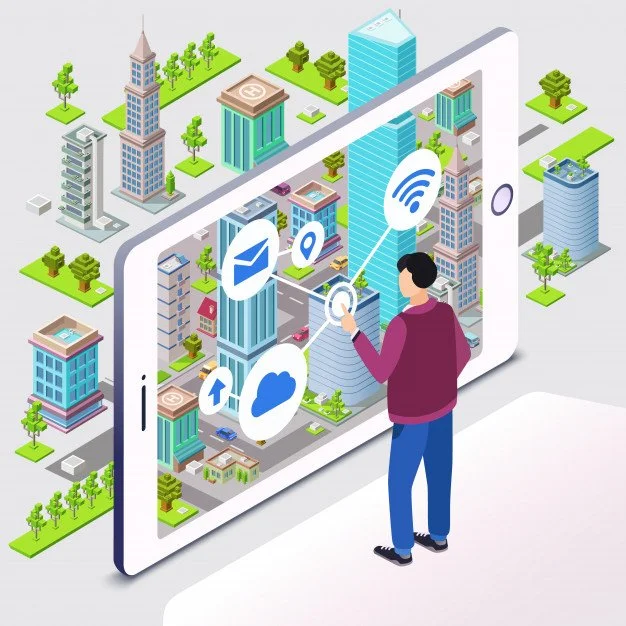
Image: [Digital artwork of a man interacting with technology against metropolis background]. Bee Market Research. https://beemarketresearch.blogspot.com/2020/03/smart-city-ict-infrastructure-market.html
