L’homme du monde: Conversations with my grandfather.
On memory, masculinity, and inheritance. Written in 2024.
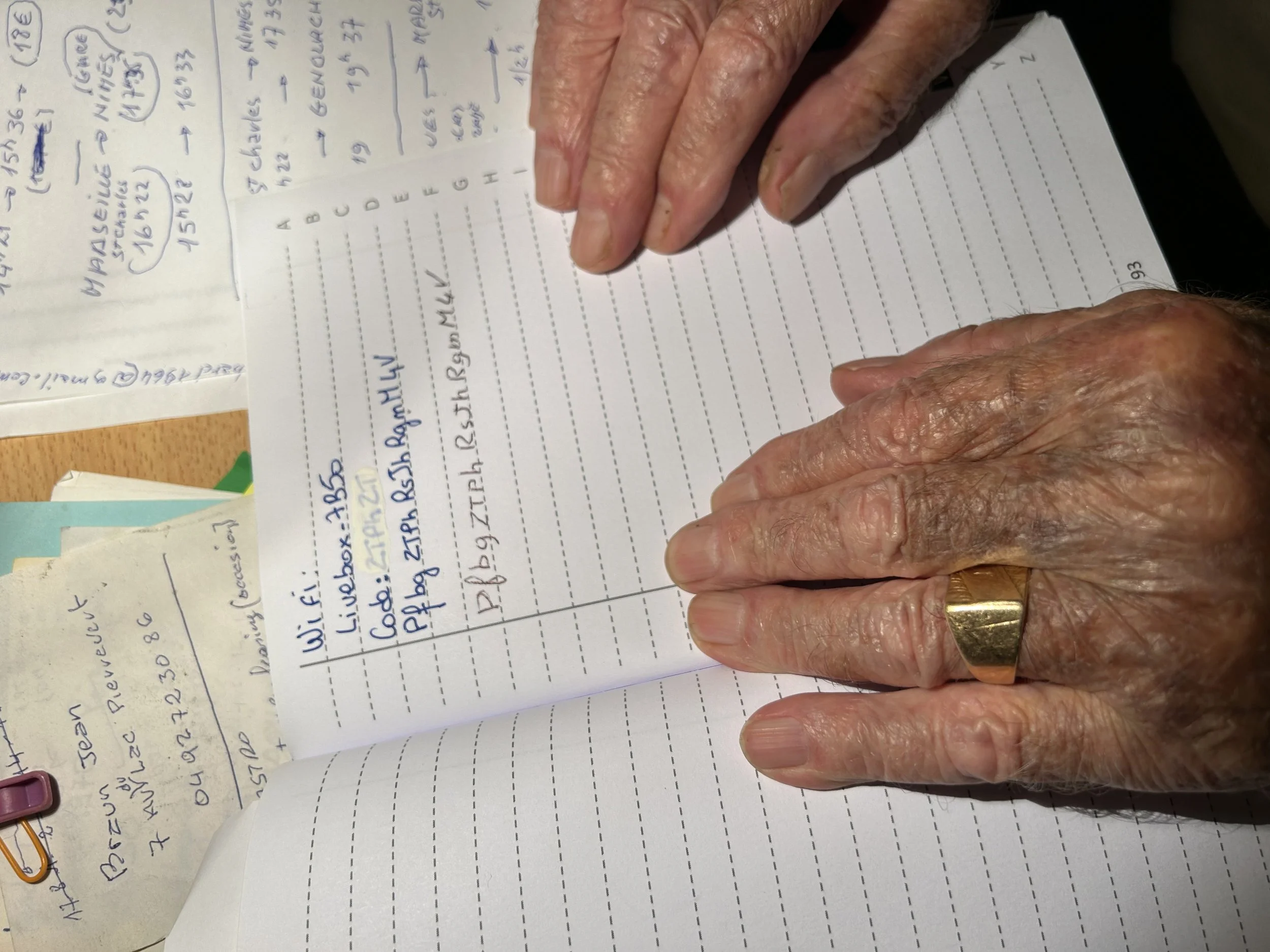
From the archive (Martigues, 2024)
If my time spent studying sociology has taught me anything outside of the theoretical realm, it would be understanding the pitfalls of arranging an interview over Zoom with a senior family member, the consequences of which had made themselves painfully clear to me prior to starting my interview with my grandfather, Claude. Blinded by my own naiveté, what had started as an intended scheduled meet-up evolved into a saga spanning the course of two hours, involving numerous international phone calls with two very helpful, supportive aunts and back-and-forth calls with Claude himself. Most of which consisted of either reassuring him that the process was not as complicated “as it sounds”, or staring at a grey screen with small text reading “connecting” accompanied by a protracted dial-tone, each reiteration of the same musical phrase bringing me closer to the edge of sanity.
Finally, success, and Claude Lombard greets me in his signature Southern-French accent, one that can only be cultivated through the authenticity of a lifetime spent in the same region. France is in this man’s blood, to the point where he is almost stereotypically French. Within the first video chat I scheduled with him prior to the interview he had appeared on-screen as he is now, seated in his kitchen, arguably the most cherished part of his house, smoking a Marlborough gold alongside another aged brown-haired French man of charismatic demeanour. The pair both sporting striped blue-and-white Breton sweaters, smiling eagerly into the camera.
I should, for the sake of context, describe Claude’s reputation in his home town and traditional stomping-ground of Martigues. The Lombard name has a profile in this town, Claude’s cousin being the current and long-standing mayor who reside within a weathered mustard-grey townhouse with shuttered windows on a street named after him. So it comes with little surprise that Claude is known as the local l’homme du monde which is, for lack of a better term, the French translation of ‘man-about-town’. Memories of visiting him throughout my childhood and adolescence comprise, in large part, of meeting various chère amies, being kissed by perfumed strangers, once on each cheek, before settling back into my chair and listening to a conversation in French spoken at a pace far beyond my level of comprehension.
Rather characteristically, pre-interview small-talk does not last for long and we get straight into it, the interview opening with him assuming the role of the interviewer, asking me whether I “want to know his date of birth”.
If a person’s experiences in life are truly of a temporal nature, eventually distilling with age into a set of characteristics, mannerisms, physical markers and attitudes that function in part as echoes of their lived past, Claude is certainly an example of this phenomenon.
His skin, grooved and weathered from long hours working under the sun, its rays doubled in their ability to damage human skin as they reflect off the cool blue water surrounding one of the numerous oil rigs he supervised. His round, exaggerated features denoting a warm, welcoming personality while two piercing blue eyes reveal a mental sharpness, moving somewhat out-of-step with his aged body.
Part of what interested me in Claude as a subject was his place in my life as vibrant character, full of contradictions, charismatic, bright and hard-headed. Throughout my own research I discovered that his relationship with his father, which proceeded his success as a Nuclear Facility supervisor and Chief Engineer working under a variety of significant, albeit controversial, oil mining companies, was markedly one of the most important facets of his own narrative.
Claude’s description of his father’s profound impact on his life trajectory, particularly in tandem with his humble beginnings as a high school drop-out living in a small town in the South of France, facilitated the exploration of a significant range of socio-political themes and sociological concepts. The most notable social themes that emerged through our interview being that of the far-right political movement in inter-war France and the first World War, however, throughout this essay I explore these events as they reveal themselves through sociological analysis and wider academic literature, engaging with key sociological frameworks and theorists including the symbolic interactionist paradigm, French sociologist Émile Durkheim and Judith Butler’s theories on gender expressionism.
The first person external to himself that Claude refers to at the start of the interview is his father, the topic of which is also repeated throughout and always mentioned in tandem with the influence he had on Claude, as his son, and how it “served him well”. He paints a clear, straight-forward portrait of his father as a strict, traditional figure who was “exigent” and “hard with [him]” (transcript, pg. 2) but who’s presence in his life ultimately “served [Claude] well” (trans, pg. 2). Claude displays a grounded awareness of the epistemological roots of his father’s worldview, referring to his possession of the “military spirit” toward the end of the interview (trans. pg 11). Claude’s ascription of the term “Military Spirit” is done out of his own validity, but refers to a very real phenomenon, an aspect of which as revealed in his description of it as “the character of discipline” (transcript, pg.11).
The notion of “the military spirit” is one that, through his fathers influence, had a profound impact on Claude’s practice of agency throughout the course of his life a fact that, through questions posed according the C Wright Mills’ Sociological template, allows further analysis of the ways in which culture is shaped through intergenerational transmission of values, attitudes and beliefs, an idea adjacent to fundamental truths pertaining to the structural functionalist paradigm and also the extent two which culture is shaped through the private and public spheres, taking into account Durkheim’s theory of collective consciousness.
Claude’s use of the word “spirit” stood out to me as something worth investigating, as his own definition of what James Ulio and various other sociologists describe as “Military Morale”. Within the Miriam-Webster online dictionary, the word “spirit” is defined as both “the activating or essential principle influencing a person” and “a mental disposition characterized by firmness or assertiveness”. Both descriptions align with various definitions of the Military Morale as they appear within academic literature, sociologist James Ulio describing the concept as being fundamentally underpinned by values such as “duty”, “discipline”, “command” and “obedience” (Ulio 1941).
However, the first concrete definition of the word assigns an additional perspective to Claude’s application of the term ‘Military Spirit’ in contrast to what Ulio asserts would be more appropriately referred to as “Military cultures” (Ulio 1941). Through equal consideration offered to all three definitions, we arrive at the hypothesis that “military spirit” is, as a collection of values and phenomenon representative of a certain type culture and institution, is a springboard for deeper enquiry to the manner in which values, attitudes and beliefs manifest on a micro and macro scale. An appropriate sociological theory for the exploration of is Émile Durkheim’s theory of Collective Consciousness, in tandem with structural functionalism as an analytical framework.
In an article written for the American journal of sociology, Ulio emphasises that efforts to “reason through the assumption” that a clear binary exists between the “military world” and “the civilian world” would be unrealistic and unproductive. He also argues that the attitude that was cultivated through military cultures is a type of “morale” created, and fostered by a “strong” masculine participant (Ulio 1941). Examples of both ideas expressed by Ulio can be found within Claude’s interpretation of events within his life. For example, the values underpinning the “Military Spirit” are passed onto Claude through his father.
Taking into consideration the clear connections between the Military Morale and the concept of masculinity, which will be explored throughout this essay, Claude’s experience is an empirical confirmation of Ulio’s theory.
To expand on this point, it is important to note that Claude had far less direct interaction and first-hand involvement with Military Culture that his father did, his father being an Aviation Instructor throughout the duration of World War 1. Military morale, for him, was something external, yet consistently present throughout the foundational years of his life, and those thereafter, an idea present within the interview, as the topic of his father surfaces recurringly. Claude’s description of the “two years” he did serve in a military environment is skimmed overspoken about and appears as a minor deviation from his grand narrative, as established within the excerpt below:
C: Before that I worked two years in the factory in France with the Americans. After that I did two years in military service for the French military in Morocco. When I returned, a French company from Paris told my father, we want to hire your son, because “il connais le services electronique”, he has experience in the field.
D: Okay, so you did that work for the military? You weren’t frontline, you worked in the electronic department?
C: Yes, during my time in the military I was a radio telegrapher.
D: I see, and how was it to go to Morocco all alone during that time? Was it hard?
C: No- because I spent my life, all my career in 20 different countries…
Thus, the fact that the Military Morale is imbibed in Claude through an external source is emblematic of the necessity of transmission of values in the creation of culture.
This idea is clearly articulated by Campante and Yanagizawa-Drott in The Intergenerational Transmission of War, in which they demonstrate the need to “understand intergenerational transmission” as existing at the heart of the journey to understanding culture itself, defined as a collection of “customary beliefs, values, and social constraints that [...] groups transmit fairly unchanged from generation to generation.” (2015). In addition, Antikainen and Torres in The International Handbook on the Sociology of Education describe interactionism as “the individual and society are unified in collective behavior, and the self […] expresses an idea of the other who is always present in all spheres of life”, (2008, pg. 150). Thus, links between Claude’s lived experience of “other” as personal emerges through an interactionist lense.
Symbolic Interactionism as defined by professor Kathy Charmaz (2014) is a theoretical perspective that assumes people “construct selves, society and reality through interaction”. Culture, through a symbolic interactionist lense is “created and maintained by […] interactions and interpretations of each other's actions.”
The paternal relationship as portrayed by Claude’s within his personal narrative raises the notion of gender performativity, for the analysis of which I will draw upon Judith Butler’s seminal text, Performative Acts and Gender Constitution: An Essay. Through the integration of external academic literature, I will also demonstrate how Claude’s description of his father’s approach to parenting demonstrates the contextual nature of gender performativity, by the investigation of wider social processes of the era.
Judith Butler’s writings on gender, performativity, and subversion have been analyzed in depth across across broad rang of humanities and social science disciplines. The crux of Butler’s argument lies in her anti-essentialist approach to gender, asserting that gender categories “female/male, woman/man, girl/boy” (1988) are cemented through performativity and are “an identity tenuously constituted in time instituted through a stylized repetition of acts” (1988). Butler’s theory is clearly illustrated through Claude’s mention of his father’s imposed notions of masculinity onto him in the following excerpt from the transcript:
C: Yes, it's the character of the discipline. For example, he didn’t want me to have long pants, when I was 15 or 17.
D: Oh really?
C: Yes, he said. You’re not yet a man. We wear pants when we're men. And you – you aren’t a man yet.
D: How did that affect you?
C: I did what I was told, I had to.
His words bring into focus the customization and adornment of the human body to create an “illusion of an abiding gendered self” (Butler 1988). The restrictive nature of performative masculinity as expressed through his father’s approach to disciplining his own son classifies it as what foundational French sociologist Émile Durkheim defines as a social fact, in that it abides to a selection of “norms and values which exist external to the individual and constrain the individual.” (Thomson 2016).
The function of dressing the human form is a semiotic strategy which, as articulated by Raphael Costambeys-Kempczynski, Claire Hélie and Pierre-Antoine Pellerin “as a system that attributes signs of symbolic value that attempt to differentiate between masculinity and femininity” (2012, pg. 8).
However, the type of masculinity projected from Claude’s father onto him as a child is also an example of gender performativity as an occurrence specific to the social context in which the act is normalized and occurs. Given his father’s extensive involvement in serving France throughout the first World War, it is important to note political developments during and after the War that altered definitions of fatherhood and masculinity in France. Throughout my own research, two texts emerged as being the most productive sources on this topic, the first being Brandon Moblo’s Failed Men: The Postwar Crisis of Masculinity in France 1918-1930, the second, Cheryl A. Koos’ Fascism, Fatherhood, And The Family In Interwar France: The Case Of Antoine Rédier And The Légion from The Journal of Family History. In his own work, Moblo describes the “masculinity crisis” in France as being a direct result of the gender role-reversal or “distortion” that occurred throughout World War One, which later repeated itself in World War Two. He explains that, due to the absence of a patriarchal figure, French women assumed traditional masculine roles during the wars, respectively, which they were expected to “relinquish” once the war ended. Such a phenomenon surfaces within the interview with Claude, in which he mentions that his mother managed her own épicerie (grocery)throughout the second World War. Moblo postulates that “the crisis”, as such, was caused in part by the “inability of returning [soldiers] to reclaim their pre-war roles […} due to the physically and emotionally traumatic nature of the war” (2008).
Koos’ analysis of fascism and fatherhood in France during the same era adds context to the “crisis of masculinity” that Moblo describes and gives us a sociological context and potential explanation for Claude’s father’s rigid approach to parenting. Koo illustrates how the rise of far-right writer and editor Antoine Rédier and fascist, reactionary leagues within France led to altered notions of masculinity post WW1 due to the “highly gendered political philosophy” such groups advertised. Rédier, who established a significant following throughout the inter-war era, strongly advocated the creation of a “new patriarchy”, “to be founded by […] ‘true men’ who strengthened the […] moral fiber of France by fathering […] large families and raising sons who would do the same.” (1999). In his 1992 speech delivered to a large crowd in front of the Fourth Congrès National de la Natalité in Tours (1999), he argued that France’s future potential as a nation rested on “familial education”, and the importance of fatherhood in maintaining patriarchal order through an emphasis on “duty, order, authority, and physical and moral strength” (1999). The notion of “duty” here establishes another link between masculinity and the aforementioned “military spirit”.
Ultimately, is not certain that Claude’s father politically aligned with such beliefs, however, given the fact that his own notions of masculinity gender performativity strongly align with cultural ideas of the time, the idea that the rules of gender expressionism abide by the era in which they emerge is made clear.
Although the broad scope of details that constitute Claude’s story were not expressed to me throughout the interview as a result of both technological issues and a slight language barrier, what was revealed through his personal narrative facilitated the discussion and exploration of sociological ideas and theories as they exist within the life of an individual. Faced with the challenge of theorising the relationship between the individual and the collective, I discovered that the existence of a profound and impactful relationship within the life of the individual can be the platform to discovering and analysing further aspects of that individual’s lived experience.
Reference list
Alberto-Torres, C. & Antikainen, A. 2003, The International Handbook on the Sociology of Education: An international assessment of new research and theory, Rowman and Littlefield, US
Butler, J. 1988, ‘Performative Acts and Gender Constitution: An Essay in Phenomenology and Feminist Theory’, Theatre Journal (Washington, D.C.), 40(4), 519–531
Campante, F & Yanagizawa-Drott, D. 2015. "The Intergenerational Transmission of War," NBER Working Papers 21371, National Bureau of Economic Research, Inc., viewed 31 May 2021, <https://scholar.harvard.edu/files/ydrott/files/intergenerational_war.pdf>
Charmaz, K. 2014, Constructing grounded theory, 2nd ed, SAGE Publications, Thousand Oaks, CA
Costambeys-Kempczynski, R., Hélie, C., & Pellerin, P. 2013, ‘Performing/Representing Male Bonds’, InMedia,viewed 30 May 2021, <https://journals.openedition.org/inmedia/451?lang=en>
Hoffmann, S. 1961, The Effects of World War II on French Society and Politics. French Historical Studies,2(1), 28-63.
Koos, C. 1999, ‘Fascism, Fatherhood, and the Family in Interwar France: The Case of Antoine Rédier and the Légion’, Journal of Family History, vol .24 (3), p.317-329.
Moblo, B. 2008, ‘Failed Men: The Postwar Crisis of Masculinity in France 1918-1930’, Student Summer Scholars. 7.
Ulio, J, 1941, ‘Military Morale’ American Journal of Sociology,47(3), 321-330. Viewed 31 May, 2021, from http://www.jstor.org/stable/2769282
‘Spirit’, in Merriam-Webster’s Dictionary, Merriam-Webster, Springfield, Massachusetts, viewed 31 May 2021, < https://www.merriam-webster.com/dictionary/spirit>
Thomson, K. 2016, What are ‘Social Facts’ ?, ReviseSociology, viewed 31 May 2021, <https://revisesociology.com/2016/12/12/what-are-social-facts/#:~:text=Social%20facts%20are%20things%20such,population%20distribution%2C%20urbanization%2C%20etc.>
